
Estate Taxes and Gift Taxes in 2026: The Basics of What High-Net Worth Households Need to Know
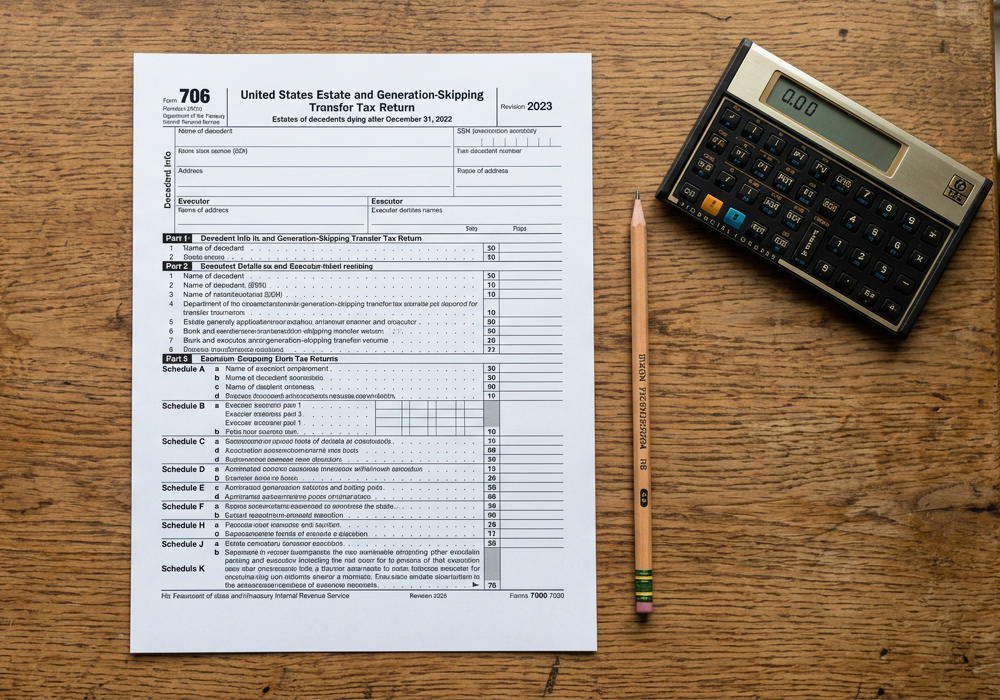
The federal estate tax exclusion is $15,000,000 per person. Most people look at the figure and say, “I’m not that wealthy, and therefore I don’t need to worry about estate tax and gift tax.” But that is not correct - there are still very important considerations that high-net-worth families need to know.
However, the reality is that most people don’t really understand how estate taxes and gift taxes work. Some of the things that people obsess over, like staying under the annual gift exclusion of $19,000 per year, actually don’t matter that much from a financial planning standpoint for most households in today’s estate tax regime - however, giving over the annual limit leads to a tax filing requirement. And there are other dangers (like being mindful of state estate taxes in certain states) that many households under-appreciate.
The objective of this post is to provide a basic overview of estate taxes and gift taxes so that households with wealth can have informed discussions with their advisors about the right steps to take in their particular circumstances.
Note: This post is for informational purposes only and is not tax, legal, or investment advice. It is strongly recommended that you not attempt to “self-manage” your potential income tax exposure, estate tax exposure or taxable gift strategy; instead, you should seek counsel from experienced financial, tax and legal advisors to determine the correct strategies for your specific situation.
The opinions expressed in any commentary posted on this site are solely those of the individual author and do not necessarily reflect the views or opinions of XY Investment Solutions, LLC (“XYIS”). These opinions are based on information available at the time of posting and are subject to change without notice. XYIS does not commit to updating any posted positions or commentary to reflect subsequent developments. While the information and reasoning used to form these opinions are believed to be from reliable sources, XYIS does not verify this information, and no guarantee is provided regarding its accuracy, completeness, or validity. XYIS disclaims any and all liability for actions taken or not taken based on the content of this site. No warranty, express or implied, is given in connection with the content provided.
I’m going to talk about seven interrelated topics as part of this post:
The federal estate tax
An overview of important estate deductions and portability features to manage the federal estate tax
The federal gift tax, the unified credit, Form 709 and Superfunding of 529 Plans
The Step-Up in Basis and “Community Property” states vs. “Common Law” states
State death tax considerations
A high-level overview of techniques to manage estate tax exposure
Time is your ally for managing estate tax exposure - don’t waste it
1. The Basics of the Federal Estate Tax and the Generation-Skipping Transfer Tax (GSTT)
The basics of the federal estate tax are pretty simple - you simply need to know the answer to these two questions:
What is the amount of the estate’s value that is subject to potential taxation?
How is that value taxed?
The answers to these questions are relatively simple: In 2026, under current rules, any amount of the value of the estate subject to taxation that is over $15 million is taxed at up to a 40% rate.
Example:
The estate is worth $16 million
The “effective exemption” is $15 million
Therefore, the amount of the estate that is potentially subject to taxation is $1 million
Therefore, the estate tax is 40% of $1 million, or $400,000 (note: in practice, it is somewhat less this amount for a $1 million taxable due to graduated tax rates, but the marginal rate reaches 40% relatively quickly for large estates)
This seems pretty straightforward; however, the actual computation of the estate in practice is more complicated. But at a high level, the thing to know is: there is no federal estate tax if the taxable estate is below $15 million, but any amount above $15 million is taxed at up to 40%. (Note: many states have a lower estate tax exemption below $15 million - a section in this post discusses state estate taxes.)
The federal estate tax is calculated on Form 706 - United States Estate (and Generation-Skipping Transfer) Tax Return. This return must be filed within nine months of the decedent’s date of death, although the deadline can be extended by an additional six months. Form 706 is only required to be filed if the gross estate is greater than the current federal exemption (which is $15 million in 2026). However, in many cases involving high-net-worth households, it makes sense to file a return even if no tax is due (especially for the deceased spouse unused exemption (or “DSUE”), as discussed below). Therefore, it is important for an executor of a high-net-worth estate to consult an estate attorney to determine whether a Form 706 should be filed.
One note is that under current law, the amount of the exemption is indexed for inflation going forward, so the amount of the exemption will grow over time.
One other thing to note is the Generation Skipping Transfer Tax. This is an additional tax that may be levied on transfers to people more than one generation younger than the decedent. The purpose of this tax is to prevent mega-wealthy decedents from reducing estate tax exposure of their children’s estate by bequeathing assets directly to grandchildren. It is estimated that only a few thousand estates per year are subject to GSTT, so this will not be discussed in this post.
So now you know the basics of how the estate tax works. But there is one tricky little question to answer: how do you calculate the “value of the estate that is subject to taxation”? And this is where things start to get complicated…
2. The Gross Estate, Deductions and the Taxable Estate
To figure out the amount of the estate subject to taxation, the framework is relatively straightforward: simply add up all of the decedent’s assets and subtract allowable deductions.
At a very high level, the total amount of the decedent’s assets is the gross estate. This includes the value of bank accounts, investments, retirement accounts, houses, other real estate interests, business interests, partnership interests, cars, boats, furniture, the death benefit paid on owned life insurance on the decedent’s life, annuities, and pretty much any other owned property that has value. Essentially, if you can sell it for value or if a beneficiary receives something of value, it’s part of the estate. There are special rules for assets that are jointly owned with a spouse with rights of survivorship. This is discussed in a later section.
From the gross estate value, deductions can be made. Two large deductions are often the debts of the decedent as of the date of death and the value of any legacy charitable bequests. Funeral costs and estate disposition costs are also deductible expenses. State esdeath taxes are also deductible.
Finally, there are two different deductions related to spouses:
For “first-to-die spouses,” there is the unlimited marital deduction, which is a deduction that is taken for assets that the spouse inherits. In practice, this simply defers these inherited assets from being included in an estate until the surviving spouse passes (although in many cases, it is better to structure the estate to avoid this outcome…this will be discussed further in a section below).
For “second-to-die” spouses, there is the “deceased spouse unused exclusion” or “DSUE.” This exemption represents the lifetime exemption that was not used by the first-to-die spouse. Important note: The DSUE is only passed on if the estate of the “first-to-die” spouse files a Form 706 Estate Tax Return. If no return is filed, the surviving spouse’s estate will not be able to claim the DSUE.
Simplified Example: Robert and Susan are spouses. Robert passes away with an estate equal to $16 million; however, Robert left $4 million to Susan, and that is a deduction for Robert’s estate, an so his taxable estate is $12 million. Therefore, Robert’s estate owes no federal estate tax. In addition, Robert’s estate has an unused exemption of $3 million that is passed on to Susan. This is because Robert has a $15 million exemption and has a $12 million taxable estate; therefore, Susan’s estate will be use that $3 million unused exemption to reduce her federal estate tax exposure when she passes away, as long as Robert’s estate files a Form 706 Estate Tax Return to opt in to the DSUE. If a Form 706 is not filed for Robert’s estate, Susan’s estate will not be able to claim the DSUE.
There are a few other minor deductions, but the above captures the most common deductions and exemptions, and the net amount is (effectively) the taxable estate.
However, there is one additional significant factor that must be incorporated before calculating the estate tax, which is taxable gifts.
3. The Federal Gift Tax, the Unified Credit, 529 Superfunding and Form 709
Before providing an overview of the federal gift tax, it is helpful to outline a scenario as to why the federal gift tax exists:
Imagine a scenario where you have less than a year to live and expect to have a $20 million estate. You know that your estate will have to pay a tax on any amount over $15 million, so for a $20 million estate, the estate might have to pay up to 40% of $5 million, i.e., a $2 million estate tax.
However, you have a clever idea: you can just give $5 million away on your death bed. And therefore, you think that your estate will now be $15 million and you won’t have to pay estate tax.
Unfortunately, the federal tax code has rules in place that effectively prevent you from getting much financial benefit from doing this workaround. And in the situation outlined above, essentially all of the $5 million gift would also be part of the calculation for determining the estate tax. In other words, the estate tax would still be calculated based on a $20 million figure, even though the estate is only $15 million at death. This is because of the gift tax and the unified credit.
3.1 The Federal Gift Tax and the Annual Exclusion
The rules around taxable gifts are very complicated, but even the basic rules about taxable gifts are poorly understood by most people. Here are the basics of the federal gift tax rules:
In any single year, you are allowed to give a certain amount to any single individual, but if you give over that amount in a single year, that overage amount is a “taxable gift.” For 2026, the federal annual gift tax exclusion is $19,000. Any “completed gifts” to a single individual at or below the annual exclusion do not need to be reported to the IRS.
Each separate donor-recipient pairing has its own annual gift tax exclusion. Example: two parents have two children, and the parents want to give the maximum exclusion to the children. Each parent can give $19,000 to each child, so each child can receive $38,000 in total without gift tax reporting obligations.
With that said, married couples should be wary of using one check to make two separate gifts to the same person. This is what is called a “split gift,” and these split gifts must be reported in all circumstances on Form 709 for the paying spouse and consented to by the other spouse; the procedures for this reporting process are somewhat cumbersome. Therefore, from a reporting standpoint, the simpler option is generally for each spouse to write a separate check for each gift recipient.
Any gift amount within a year above the annual exclusion is a taxable gift and must be reported to the IRS on Form 709.
It is important to note that for MOST non-wealthy people, filing a gift tax return does not result in needing to pay a tax! The purpose of the gift tax return is to simply inform the IRS of gifts that exceed the annual exclusion, so the IRS can track it. For people who don’t expect to have federal estate tax issues, it is completely fine to give more than the annual exclusion! This includes gifts to 529 plans…you can contribute more than the annual exclusion amount to a 529 plan. You would just need to report the amount of the gift to the IRS via Form 709.
Donating almost anything of value to a person is a gift. For example, if you give your daughter a house or a car, that is a gift that must be reported. 529 plan contributions are also gifts. However, there are a couple of important exceptions:
Qualified education expenses: these are payments made directly to an educational institution for tuition and other mandatory fees. While there is no limit for undergraduate and graduate tuition payments, there are limits on how much tuition paid can be excluded as a gift for K-12 private schooling. In addition, room and board is generally not a qualified expense and must be treated as a gift. Also, 529 contributions are not qualified education expenses for the purposes of gaining an exemption from gift tax return reporting requirements. Contributions to a 529 plan by someone other than the beneficiary are always completed gifts.
Qualified medical expenses: these are payments made directly to a medical services provider or for other qualified medical expenses paid directly by the donor. These are almost always excluded from being treated as a gift.
It is important to note that both of the above exemptions only apply when the payment is made directly to the service provider. Example: Mary incurs $50,000 of hospital bills, and Julie wants to help her. Julie writes a $50,000 check to Mary, and Mary then deposits that check and uses that money to pay the hospital. In this situation, Julie made a $50,000 gift to Mary, and she would be obligated to report some or all of the gift to the IRS. If Julie had instead paid the hospital directly, none of the payment would have been treated as a taxable gift as long as the expenses were qualified medical expenses.
Trump Account Contributions: There is one major condition for any gift to qualify for the annual exclusion, which that it must be a completed gift. One of the legal conditions of a “completed gift” is that the beneficiary must have the right to the funds upon the gift being completed. By that definition, Trump Account contributions are not “completed gifts” because a beneficiary of a Trump Account under the age 18 does not have the right to the funds upon the completion of the contribution. However, the IRS recently released rules that didn’t require Trump Account Contributions to be reported on Form 709 under certain conditions, two of which are highlighted here: (i) as long as the overall amount of gifts per individual did not exceed $19,000 and (ii) as long as there was no other requirement to file Form 709.
Example: you make a contribution to a Trump Account for Child #1, but you also put $30,000 in the Child #2’s 529 Plan. In this case, the Trump Account Contribution would need to be reported on Form 709 because the $30,000 gift created a Form 709 filing requirement, and the Trump Account Contribution would be treated as a taxable gift.
Because of the intricacies of Trump Account gift tax reporting rules, it is very important that you consult your tax advisor if you are considering making a Trump Account contribution in addition to any other gift to any recipient (including a 529 contribution) to determine whether that would trigger a Form 709 filing requirement. Consult an advisor BEFORE making a gift.
529 Plan Contributions: 529 plan contributions are treated as completed gifts. See the sub-section below for more information on the treatment of 529 plan contributions.
So to sum up: generally speaking, any gift below the annual exclusion is not reportable to the IRS. However, any gifts above the annual exclusion (of $19,000 per year in 2026) are reportable to the IRS, because these are taxable gifts. And the IRS will keep track of the running total of taxable gifts that a donor has made during their lifetime, because that total will be used in calculating the total estate tax of the giftor’s estate. How that happens is through something informally called “the Unified Credit.”
3.2 The Unified Credit: Taxable Estate + Taxable Gifts
Remember where I said at the beginning of this post that the estate tax applies when the taxable estate is more than $15 million? Well, that wasn’t quite right, because the actual limit of $15 million is the sum of estate value plus lifetime taxable gifts. In normal parlance, tax practitioners call this exclusion the Unified Credit.
Think of the Unified Credit like this: to give money to people, you can either (1) give money to other people in your lifetime or (2) give money to people upon your passing. (1) is “lifetime gifts” to individuals and (2) is bequests to individuals. One way or another, you are giving money away to some person.
But the IRS doesn’t want you to give money away to get out of your obligation of paying estate tax. And that is why the concept of “taxable gifts” exists: if you start giving lots of money away during your lifetime, that will effectively reduce the size of the estate that you can have before estate taxes kick in.
However, the IRS doesn’t care about dinky little lifetime gifts. If grandma gives a $10 gift to her grandson Bobby, the IRS doesn’t want to know about that. In fact, the IRS doesn’t care about a gift of a few thousand dollars in a year.
Where the IRS starts to care is if you give away money to any individual that is more than the annual exclusion, which is $19,000 in 2026.
Wealthy families do use the annual exclusion quite often to reduce the size of their estates by making taxable gifts. A long-term strategy of annual giving to multiple individuals is a very effective tool for reducing future estate tax liability for wealthy families.
Moreover, it is quite often beneficial for very wealthy families to intentionally make taxable gifts above the annual exclusion even though it effectively reduces their remaining unified credit, especially if they still have many years to live. Why? Because if they hold on to those assets, they will grow in value, resulting in even more estate tax exposure once the household members pass away. Moving that growth outside of the estate can make sense in many (though not all) situations.
In fact, for very, very wealthy families, they may often make taxable gifts in excess of the Unified Credit simply to move assets out of the estate. And when they do that, here is what happens: they have to pay a gift tax of 40% on most lifetime gifts over the Unified Credit. (Note: the tax on the first $1 million of gifts is slightly less than 40%, but I’m going to assume a flat 40% tax for the purposes of this post.)
Example: John has $100 million of assets. He decides to make a $20 million gift to his son. This is the first taxable gift that he has made in his lifetime. $15 million of the gift is tax-free, but $5 million is subject to the 40% gift tax, so he has to pay (approximately) $2 million of gift taxes, and since John has used up his lifetime unified credit, he needs to pay this tax himself in conjunction with the gift tax return. In addition, although John has used up his lifetime Unified Credit, he may gain access to new tax-free giving opportunities in the future if the Unified Credit increases in the future.
Why would John do this? Because it may result in a better long-term tax outcome, since it reduces long-term estate tax exposure. The future investment growth of all those assets won’t be subject to a 40% federal estate tax in John’s estate.
In practice, very wealthy families use a variety of techniques to gift assets, especially using irrevocable trusts as vehicles to receive assets. This is discussed at a high level later in this post.
The key takeaway from this section is the following:
If you expect that the sum of your estate value plus the sum of your taxable gifts is going to be well under $15 million, you don’t have to worry about federal estate taxes (under current rules).
However, there are 3 important caveats to the above point:
You may have to worry about state estate taxes - see Section 5 below.
This assumes Congress does not change the Unified Credit. (A future Congress could reduce the current $15 million exemption to a lower level.)
Even though you may not owe estate tax in the future, you may still need to file Form 709 if you make taxable gifts in excess of the $19,000 annual exemption. And Form 709 is very annoying to fill out and report.
3.3) Form 709 Reporting Requirements - Not Easy
Let’s say that you decide that you would like to make a $50,000 gift to someone. Since you are making a taxable gift, you will need to fill out Form 709 and list that gift and any other taxable gifts you make.
Sounds easy, right?
Unfortunately, Form 709 is a surprisingly laborious tax filing to complete. Moreover, consumer tax preparation software like Turbo Tax generally does NOT support Form 709, so your choices are to complete the form manually (ugh!) or hire a tax preparer, and for most people it makes sense to hire a preparer to do this form. I’m sorry that this is usually the best action to take, but the reality is that filling out a Form 709 is brain damage for most households. Spend a couple hundred dollars and get a pro to do it for you, and save yourself the grief.
Form 709 is NOT part of the Form 1040 filing so you don’t file it with the Form 1040; however, the deadline for filing the Form 709 is the same as the Form 1040 filing, and if you request an extension for the Form 1040, the extension also applies to the Form 709. As a note, many tax pros will request that you file for an extension if you need to file a gift tax return, because it can take some time to complete, even in relatively straightforward circumstances.
3.4) Form 709 and Superfunding of 529 Plans
There is one additional fairly common yet little-known circumstance where you are required to file Form 709, which is for superfunding 529 plans.
By law, a gift to a 529 plan is a completed gift, and therefore any gift over $19,000 needs to be reported to the IRS on Form 709.
However, there is a special rule for gifts to 529 plans, which is that donors can contribute up to five years of taxable gifts in one year and, if they follow the rules, not make a taxable gift. This is informally called “529 Plan Superfunding”. So in 2026, a person could make a $95,000 gift to a 529 plan and, IF THEY FOLLOW THE RULES, not have it be treated as a taxable gift. This does mean that the donor cannot make any additional excluded gifts in the following four years to the recipient, either to the 529 plan or directly to the recipient; if they do, they would be making taxable gifts.
Many consumers are vaguely aware of this “529 superfunding” feature of the tax code without truly understanding the reporting requirements of these gifts.
In fact, when you superfund a 529 plan, you are required to file Form 709, at least for the year of the superfunding and report the amount equal to 1/5 of the superfunding amount in that year. You also need to provide a supporting disclosure. In the following four years, however, you do not have to file a Form 709 if, besides the superfunding, you don’t have a gift tax return reporting requirement.
Unfortunately, most consumers aren’t aware of this reporting requirement because they don’t know the rules, nor do 529 plan providers provide much education on the reporting requirements related to superfunding of 529 plans. (529 plan providers have a financial incentive for getting more assets into 529 plans, so they may not have a strong interest in educating consumers on time-consuming taxable gift tax return reporting requirements.)
Given this reporting requirement for 529 plan superfunding, the cost and hassle of Form 709 reporting makes superfunding a bit less attractive in practice. Very often when I work with clients, I recommend simply doing annual gifts under the annual exemption to eliminate the reporting hassle, because the actual tax benefits with superfunding may not be that much more given the compliance costs and “hassle costs.”
4. The Step Up in Basis on Death and “Common-Law” vs “Community Property” States
4.1 Step-Up in Basis
Many assets included in an estate receive a step-up in basis upon death. What that means is that the cost basis is “stepped up” to the current value at death, wiping out all unrealized gains on many assets in an estate.
Example: Mary just passed away. 30 years ago, she bought 5,000 shares of Microsoft stock for $5.00 per share for a total purchase price of $25,000. When she died, the stock price was $400 per share, meaning that the shares’ overall value was $2,000,000. Her daughter Gina inherits the stock, and if Gina sells the stock for $400 per share, she will pay no capital gains tax.
Note in the example above that if Mary had sold the stock before she died, she would have owed capital gains taxes on the difference between the total purchase price and the total sale price of the 5,000 shares, and if she lived in a state with a state income taxes, a state income tax would have applied as well. But since Mary died, the tax basis gets stepped up to the value on the date that she died.
This is obviously a large tax benefit to a decedent’s heirs, and for assets that have appreciated significantly in value, pursuing a strategic approach regarding these assets is essential.
Almost all personally-owned assets in an estate benefit from this step-up-in-basis provision, including real estate, stock, bonds, business interests, partnership interests and collectibles.
However there are many types of assets that, even though they are included in gross estate value, do NOT receive a step-up in basis. These include:
Traditional IRAs and other pre-tax retirement accounts (such as a pre-tax 401(k)s)
Annuities (especially deferred non-qualified annuities)
Installment notes receivable
One note on non-qualified annuities: one reason that deferred non-qualified annuities are an inferior long-term investment vehicle in today’s tax environment is that unlike other investable assets like stocks and ETFs, deferred annuities do NOT receive a step-up in basis. For wealthy individuals who have owned these annuities for many years, the lack of step-up is a huge disadvantage, and it is an important reason why many wealthy families should consider surrendering their deferred annuities and moving those assets to a traditional brokerage account, especially if they have many years to live and don’t intend to annuitize the annuity.
Roth IRAs do not need a step-up-in-basis, because by law any qualified distributions from Inherited Roth IRAs are tax-free.
4.2 The trade off between the step-up-in-basis vs. gifting for estates facing an estate tax
For most families that aren’t facing an estate tax situation, taking advantage of the step-up-in-basis is a priority in estate planning for assets that have significantly appreciated in value, because it provides a large tax benefit to heirs at no cost for the estate. However, for estates facing a potential estate tax liability at either the federal or state level, there is often a trade off between taking advantage of the step-up in basis vs. minimizing estate tax. Consider the following example:
Example: Thomas is a wealthy investor whose estate value is likely to exceed the $15 million federal exclusion. He has one daughter, Lucy. One of his holdings is $2 million of NVIDIA stock that has gone up 10x over the last three years. Thomas expects to live another 10 years. Thomas believes that he has two options:
Thomas could give the stock to Lucy. This would result in a taxable gift of $2 million, but it would get any future growth out of the estate, potentially saving his estate some estate tax if NVIDIA stock continues to appreciate in value. However, Lucy will get the carryover basis, and if she sells the stock will have to pay capital gains tax on the difference between the sale price and the cost of the stock when Thomas purchased it, likely resulting in significant capital gains taxes for Lucy.
Thomas could also retain the stock until he dies, and if he does that he will get a step-up in basis on the stock, and Lucy could then sell the stock without paying any capital gains taxes. However, Thomas’s estate will likely have to pay a 40% estate tax on the total value of the stock. This will be very costly, especially if the stock continues to appreciate.
So what is the right thing to do? It depends on the details of Thomas’s overall situation (as well as Lucy’s situation), and it depends on Thomas’s view on whether the NVIDIA stock will continue to appreciate or not.
What this situation demonstrates, however, is one of the tricky trade-offs that wealthy families face when they consider strategies for assets that have appreciated significantly. Moreover, the strategy has to be chosen as part of an overall plan for the entire estate.
These considerations also apply for residents of states that have their own estate tax, which typically have a lower exemption level than the federal estate tax. However, state estate taxes typically have lower tax rates, so the calculus is very different if the state estate tax will likely apply, but the federal estate tax will not. This is discussed in a later section.
4.3 Step-Up-In-Basis for Property Owned by Spouses: “Common-Law” vs. “Community Property” States
Up to now, we have only talked about property that was held by one decedent. But what happens if property is jointly owned with rights of survivorship?
Example: Gary and Cindy are married and they own their home jointly with rights of survivorship. They bought the house for $300,000. Cindy dies, when she dies the house is worth $700,000. What is the stepped-up cost basis for Gary now that he owns the house outright after Cindy’s death?
The answer is: it depends on the state in which the house was located, because there are two different ways that states calculate the value of the house that is in the estate and the amount of step-up.
At a high level, there are two different methods that states use by default when it comes to how jointly-owned assets between spouses are treated as part of the estate process: the “common law” approach and the “community property” approach.
Common Law or “Separate Property” Approach
Most states use the “common law” approach. Under this approach, only the decedent’s share of the value of the house is included in the cost basis and fair market value.
So using the example above, if Cindy dies, the new basis of the house for Gary is:
Gary’s share of the basis of the house, or 50% of $300,000, or $150,000, PLUS
Cindy’s share of the new basis of the house, or 50% of $700,000, or $350,000
That sums up to $500,000, and this is the new basis in the house.
Another way to think about this is that the old basis on the entire house was $300,000, and the house appreciated $400,000. However, the survivor only gets a half step-up, or 50% of $400,000, or $200,000. Therefore the new basis is $300,000 plus $200,000, or $500,000.
The value of the house that is in the Cindy’s estate is $350,000, not $700,000.
Community Property Approach
Note: the rules around community property are especially complicated, and if you live in a community property state and are married or considering getting married, it is extremely important that you work with qualified legal counsel on developing an estate plan and other legal plans that meet your goals.
There are nine states that use the community property regime. The states that use community property rules by default are: Arizona, California, Idaho, Louisiana, Nevada, New Mexico, Texas, Washington and Wisconsin. In addition, four other states have established laws that enable households to opt in to community property treatment via the creation of a trust.
For couples in community property states, all property purchased during the marriage, whether owned jointly or by either spouse individually, is generally considered community property. However, property purchased prior to the marriage is generally treated as separate property, not community property, as long as the spouses don’t commingle separate property assets with community property assets.
When one spouse living in a community property state dies, the treatment of community property is different when it comes to the estate. Unlike in common law states, community property receives a full step-up-in-basis, not a half step-up-in-basis. However, the full value of the community property is also included in the decedent’s estate.
For households that are not facing estate tax issues, that full step-up-in-basis can be very valuable for the surviving spouse, because the surviving spouse can then sell any stepped-up assets with little or no capital gain recognized. For instance, the spouse could sell appreciated stock or the jointly-held home that is treated as community property without paying much if anything in capital gains taxes. In addition, when the surviving spouse passes, those assets will receive a second step-up in basis (i.e., the “double step-up”).
However, for households that may have estate tax issues, community-property tax treatment can be less desirable because now the decedent’s estate will be larger and may be exposed to a large estate tax.
In any case, it is important for wealthy couples living in community-property states to seek legal counsel before they get married to understand the implications of community property rules, and this is even true for households that do not have estate tax issues. This is especially true for “second marriage” and “mixed-family” households; they should always seek experienced legal counsel in their state to understand how their estate would be administered under that state’s rules.
5. State Estate Tax and Death Tax Considerations
So far, we have only discussed estate taxation at the federal level. However, many states also impose estate taxes at the state level. These taxes are in addition to federal estate taxes; however, it is important to note that state death taxes paid are a deduction for the purpose of calculating the federal estate tax.
There are a few important considerations.
5.1 State Estate Tax Considerations
There are several general important things to know about state estate taxes and other death taxes:
Which states impose a state estate tax?
How large is the estate tax exclusion?
What is the top tax rate?
Are there state-specific rules?
Which states impose an inheritance tax?
Note: an inheritance tax is different than an estate tax. While an estate tax is paid by the estate, the recipient of the inheritance is legally responsible for paying the inheritance tax (although, in practice, the estate often pays the inheritance tax on behalf of the beneficiary). There is one state (Maryland) that imposes both an estate tax AND an inheritance tax, and in this case, both types of tax need to be considered as part of estate planning.
Because state estate tax laws are constantly changing, I would recommend consulting the following resource to understand whether the state you live in imposes an estate tax or inheritance tax. I have found that the below resource at the Tax Foundation website is updated on at least an annual basis.
The key takeaways from this table are:
There are many states that impose an estate tax.
The exclusion at the state level is almost always lower than the federal exclusion of $15,000,000. In some cases, the exclusion is extremely low. For instance, Massachusetts only provides a $2,000,000 exclusion under current law.
However, the estate tax rate at the state level is much lower than federal estate tax.
There is one other major difference between federal estate and state estate tax rules: most states do not provide portability between spouses:
Example:Frank and Donna are a high net-worth couple living in Vermont with $9 million of assets. Vermont has an estate tax exemption of $5 million. Frank dies, and his estate is $3 million dollars - therefore Frank has an unused estate tax exemption of $2 million. The next year Donna dies and her estate is $6 million - after the exemption, she has a $1 million taxable estate. Unfortunately, Donna cannot use Frank’s unused lifetime exemption of $2 million under Vermont law, and Donna’s estate will need to pay estate taxes on the $1 million taxable estate.
The combination of “lower exclusion but also lower tax rate” and the lack of portability in many states changes the planning considerations considerably. This is especially true because the concept of “taxable gifts” does not exist in most state estate tax regimes, as discussed in the “State Gift Tax Considerations” section below.
5.2 State Gift Tax Considerations
Remember the story from the middle of this post about the person who tried to make a death bed gift to their heirs to eliminate the estate tax and how that didn't work under federal law because of federal gift taxes?
That problem often does not apply to many state estate taxes, because many states don’t tax gifts. Under most state tax codes, gifts of any size and at any time do not create taxable gifts. People making large gifts in these states will need to report these gifts to the IRS, but not to the state.
Example: Maureen lives in Maryland, which has a $5 million estate tax exemption at a maximum 16% tax rate. She has one daughter. Maureen recently received a terminal diagnosis and has 2-3 years to live. Maureen has $6 million of assets, including a $1 million house, a $2 million retirement account, $2 million of cash and a $1 million Roth IRA.
In order to reduce her estate below the $5 million exclusion, Maureen gifts $1.5 million of cash to her daughter. Because of the gift, Maureen’s assets are now $4.5 million. Maureen will have to report the gift to the IRS on Form 709, but she will not have to report the gift to the state of Maryland, and the gift will not reduce the amount of the exclusion for Maryland estate tax purposes.
As of 2026, there are only three states that potentially can tax gifts, Connecticut, New York and Vermont. Connecticut has taxable gift tax rules similar to what the IRS has, but the exemption is very high. New York only taxes gifts made three years before the death of the individual. Vermont taxes gifts within two years of death.
5.3 State Inheritance Taxes
The other type of state death tax is an inheritance tax. Unlike an estate tax, an inheritance tax is a tax on assets that are transferred from the decedent’s estate to another individual.
There are currently five states that levy an inheritance tax:
Kentucky
Maryland
Nebraska
New Jersey
Pennsylvania
Each state has its own rules for how the inheritance tax works. In particular, states may apply different inheritance tax rates depending on the relationship of the recipient of the inheritance and the decedent. Spouses’ inheritance is typically not taxed. Lineal relations such as children and parents are typically taxed at the lowest rates, while inheritance to lateral heirs (like nieces or nephews) or unrelated individuals is taxed at the highest rates.
Inheritance taxes add an additional wrinkle into estate planning. Similar to estate taxes, inheritance taxes can often be minimized through lifetime gifting, and lifetime gifting should often be strongly considered for non-lineal descendants, since inheritance to these descendants often has higher tax rates. However, some states have rules in place that will impose inheritance taxes on gifts shortly before death.
5.4 Selected considerations for households facing state estate taxes but not federal estate taxes
Because the state estate tax exclusion in most states is lower than the federal exclusion, there are many families who do not have to worry about federal estate tax but do have to worry about state estate taxes. There are a few key concepts with these families.
Taxable gifts for those with estates expected to under the federal lifetime exemption
Unless you live in New York, Connecticut or Vermont, the easiest way to reduce exposure to state estate taxes is to simply make lifetime gifts, which takes assets out of your estate. A form 709 filing to the IRS will be required for any gifts over the federal annual exclusion.
However, there is one downside from gifting some assets: you lose the step-up in basis. This is especially a problem for assets that have significant unrealized gains, as discussed in the following subsection.
There is one other consideration for this strategy, which is that the current generous $15 million lifetime federal exemption may be lowered at some point by a different Congress and president. If the lifetime exemption is lowered and a person had intentionally used up a substantial portion of their unified credit through lifetime gifts, there may be very limited flexibility in the future to minimize estate tax liability.
The Tradeoff between Step-Up-In-Basis vs. Gifting
To illustrate this tradeoff, consider the following similar yet different scenarios:
Scenario #1 - Low-Basis Asset: Joan has $7 million of assets. She lives in Maryland and thus is subject to a 16% estate tax on any amounts over $5 million. Her main liquid asset is $2 million of NVIDIA stock, which she bought for $200,000 several years ago. If she doesn’t sell the stock, that $2 million of stock will be subject to Maryland estate tax of 16%, and her estate will owe approximately $320,000. However, if she gifts the shares to an heir prior to her passing, and the heir decides to sell the stock, the heir would owe up to 23.8% of the gain in federal taxes PLUS state income taxes on any gain, That may result in $500,000-$600,000 in taxes owed.
Scenario #2 - High-Basis Asset: Jean also has $7 million of assets. She lives in Maryland and thus is subject to a 16% estate tax on any amounts over $5 million. Her main liquid asset is $2 million of NVIDIA stock, which she bought a year ago for $1.8 million, so her unrealized gain is only $200,000. If she doesn’t sell the stock, that $2 million of stock will be subject to Maryland estate tax of 16%, and her estate will owe approximately $320,000. However, if Jean gifts the shares to an heir prior to her passing, and the heir decides to sell the stock, the heir would owe up to 23.8% of the gain in federal taxes PLUS state income taxes on any gain. But because the gain is only $200,000, the maximum total tax liability from selling the shares would only be around $65,000 (including both federal and state taxes), and it could be significantly less than that depending on the heir’s tax situation.
Notice that there is only one difference between the above scenarios: the unrealized gain on the asset potentially subject to estate tax. In both cases, the amount of estate tax is the same, but the value of the step-up-in-basis is much higher for the low-basis asset.
Consequently, the general principle for which assets to gift in situations where there is likely to be state estate tax but not federal estate tax is the following:
High-basis assets (especially cash) should be gifted
Low-basis assets should not be gifted and should instead held until death in order to get access to the step-up
(Note: there are many individual situations where this guidance may not be correct, and it is important to work with an estate attorney and a tax professional to develop an overall estate plan to determine the correct estate planning strategy for your particular situation.)
When the estate will primarily consist of low-basis assets and retirement accounts
There are often situations where a family is facing state estate taxes and doesn’t have many high-basis assets. The question then becomes: should the household gift assets anyway?
In some cases, the answer is no. This is especially for assets that have grown significantly in value. Instead the household should simply hold the assets until death, get access to the step-up and pay the associated estate tax.
But in most cases, the answer is “it depends.” Important factors to consider are the mix of account types, the specific mix of gain among the various assets, the specific details of the state’s estate tax system, and the heirs’ tax situation.
-
One final note on state estate taxes: Given the significant run-up in both stocks and real estate over the past few years, many households may not realize that their estate might be subject to estate taxes.
This is especially true in places like Oregon and Massachusetts that have a combination of an extremely low estate tax exclusion and significant growth in real estate values. I have run into a couple of situations where children of parents in Massachusetts were shocked to learn that their parents’ estate incurred significant estate taxes. For the most part, at least some of this estate tax was potentially avoidable. Quite often, there were many high-basis fixed-income assets in these estates that probably should have been gifted prior to the parents’ death. Instead, those assets were subject to estate tax.
6. Selected Techniques to Reduce Estate Tax Exposure
6.1 Outright Gifts to Individuals Below the Annual Exclusion
By far the most straightforward technique is simply giving money to individuals below the annual exclusion. The benefits of this approach is that it’s easy, and there are no reporting requirements. The downside is that you can only gift $19,000 to any single individual, but by giving to multiple individuals (e.g., children and grandchildren), you can potentially move a significant amount of money out of your estate every year.
Despite the annual limitations of this approach, it is important to think about annual gifts under the annual exclusion as at least a piece of a multi-year strategy. By consistently applying this strategy for many giftees over many years, many hundreds of thousands or millions of dollars can be moved out of the estate without gift tax consequences, especially for a married couple.
6.2 Outright Gifts to Individuals Above the Annual Exclusion
As discussed in the section on state estate taxes, gifts above the annual exclusion is a particularly interesting tactic to consider for households that will be subject to state estate taxes but won’t likely be subject to federal estate taxes. This is an especially valuable technique if the person subject to potential estate tax has lots of high-basis assets - in general, those assets should be gifted. In some circumstances, trusts should be considered as a vehicle to which the gifts should be provided.
6.3 Charitable Giving
Charitable giving is a powerful estate tax planning technique that provides potential lifetime tax deductions and reduces overall estate tax exposure. To the extent that a person has charitable legacy goals and is likely to have exposure to estate tax at either the federal or state level, it is extremely important and extremely valuable to work with an experienced financial advisor, tax advisor and estate attorney to develop an integrated lifetime giving and legacy plan to maximize the value of lifetime deductions and minimizing exposure to estate tax. This is especially useful when the person can create a 10-20 year plan of lifetime charitable giving.
In addition, a person with charitable interests could create legacy provisions to manage estate tax exposure. For instance, a person’s will or revocable trust agreement could state that the estate would make charitable contributions after the decedent’s passing such that the estate tax exposure is zero (or some other number). That flexibility would provide the estate the ability to maximize proceeds to survivors while still managing estate tax exposure.
If you will be exposed to estate tax at either the state or federal and have significant charitable giving interests, you should run, not walk, to assemble a team of advisors that can create the right long-term charitable giving plan for you.
6.4 Lifetime Gifts and Bequests to Irrevocable Trusts or Other Vehicles / High-Level Discussion
There are many reasons a very wealthy household may decide to gift assets to a trust instead of simply giving the money directly to a giftee. Some of these include:
The person receiving the money isn’t capable of managing their financial affairs.
There are valuable closely-held business interests. A typical situation involves private business of a material value. Certain techniques allow a grantor to make a gift while the asset value is low to reduce future estate tax exposure while also providing governance provisions that ensure business continuity. There are many techniques that households can use to minimize the estate tax related to the value of the business and to ensure continuity of the business.
Removing assets from the surviving spouse’s estate. Consider the following scenario. If a first-to-die wealthy spouse bequests all their assets to the surviving spouse, that means that all future growth of those assets will be subject to estate tax. Instead of doing this, a household could opt to bequest all or a portion of their assets to a trust, with the survivor being an income beneficiary and the children being named remainder beneficiaries - those children would receive those assets upon the passing of the surviving spouse. The benefit of this is that all the assets in the trust are out of the surviving spouse’s estate.
There is a very valuable residence. There is a special type of trust called Qualified Personal Residence Trusts, and in some cases these trusts can provide important estate tax planning benefits.
A discussion of all situations where trusts and other advanced estate techniques may be applicable is beyond the scope of this blog post. Suffice to say: there are many, many different types of trusts that households can use to achieve estate planning goals; however, there are often tradeoffs between using one strategy versus another strategy. Consequently, there are rarely any rules of thumb, and a customized strategy developed by an experienced advisory team is always required.
6.5 Intentional Roth Conversions (in limited situations)
In selected situations, Roth Conversions can be a useful techniques managing estate tax, especially in situations where the estate tax exposure is marginal.
Consider the following example: let’s say that a wealthy individual has $10 million of assets, of which $5 million is in a pre-tax retirement account that may be exposed to estate tax in the future. The individual wants to take steps to reduce the value of the future estate to minimize potential exposure to estate tax.
One of the steps the individual could consider is doing a Roth Conversion on the entire amount immediately or over many years. Doing a Roth Conversion of that size (even over many years) will likely be taxed at a 35% or 37% federal tax rate for a high-income individual, but even so, that might not be a bad option.
First of all, payment of the payment of the tax does reduce the size of the individual’s future estate.
Second, given the relatively new 10-year withdrawal period for Inherited IRAs, the pre-tax Inherited IRA distributions may push the beneficiary’s tax rate into a high tax bracket anyway for an IRA of that size, so quite often the question is not whether the IRA distributions will be taxed at a high tax rate, but when.
Finally, there is a significant other side benefit of doing a Roth Conversion for intergenerational planning reasons: under current rules, the beneficiary of an Inherited Roth IRA has the option of leaving money in the Roth IRA for 10 years after death, and that provides 10 years of tax-free growth. That 10-year period of tax-free growth is not available if the pre-tax retirement account is not converted to Roth prior to death.
Therefore, given the many potential benefits of Roth Conversions, many wealthy households with large pre-tax IRAs could reasonably consider that paying the tax associated with Roth Conversions provides many benefits, including the ability to manage exposure to estate tax.
7. Time Can Help Mitigate Estate Exposure
Here are the big takeaways that you should take away from this blog post.
If your estate is large enough that it may be exposed to estate tax, there are no “rules of thumb” to follow. Every household’s situation is different, and you need to seek out advice from experienced financial, legal and tax advisers to determine the right strategies for your situation.
For federal estate tax:
If you don’t expect to have anywhere close to $15 million of assets (including life insurance death benefits) at death, you probably don’t have to worry about federal estate tax.
The major risk is that a future Congress reduces the estate tax exclusion.
But if you make any taxable gifts above the annual gift exclusion of $19,000, you will still need to file a Form 709. You may also need to file a Form 709 if you make contributions to a Trump Account.
If you do expect to have an estate near or above $15 million, you are strongly advised to seek experienced financial advisors and tax and estate counsel to evaluate steps to minimize exposure to federal estate tax.
For state estate and inheritance tax:
Not all states have an estate tax, but for those who do, the exclusion is usually much lower than the federal exclusion of $15 million.
Therefore, a much larger proportion of households in these states is exposed to potential state estate taxes.
However, the tax rate is much lower at the state level than at the federal level; that changes which tactics to consider if only state estate taxes are an issue.
In addition, most states don’t consider gifts over the federal annual gift tax exclusion to be taxable; therefore, gifts can often be a powerful tool to reduce state estate tax exposure. However, step-up vs. gifting tactics must be compared.
In addition, a few states have inheritance taxes (especially for non-lineal descendants).
If you live in a state with a state estate tax and have total net worth of even “only” a couple million dollars, you should consider developing a plan for managing state estate tax exposure - this includes consulting experienced advisors who can discuss considerations and options relevant for your situation.
The most valuable asset that wealthy families have to minimize estate tax exposure is time.
The worst situation is someone on their deathbed who realizes that they are exposed to estate taxes and wants to do something about it. Unfortunately, by then it is often too late to significantly reduce estate tax exposure, particularly at the federal level.
This is why a wealthy household’s most valuable asset is time.By working with advisors 10, 20 or even 30 years before death, a household can often greatly reduce their exposure to estate tax.
However, this does require engaging with financial, legal, and tax advisors and continuing to work with these advisors over time as the household situation evolves and priorities inevitably change
One final point: given the significant gains in the stock market over the last 15 years, there are a lot of elderly families who have much more wealth than they would have ever anticipated, and they may not have ever thought that an estate tax would apply to them. But especially in states with low estate tax exclusions, it is very likely that their estates will be subject to state estate taxes.
Right now, I see way too few wealthy elderly households addressing this issue actively, and as these households age, they are running out of time to understand their estate tax exposure and take active steps to address it. So if you think that you are in this position or if you have an elderly parent in this situation, the advice is: seek experienced counsel, because the potential savings to the heirs from taking action may be significant.
Frequently Asked Questions
What is the federal estate tax exemption in 2026?
In 2026, the federal estate tax exemption is $15 million per person. Estates are taxed at 40% on the amount above the exemption. This exemption is “permanent” and adjusts for inflation beginning in 2027; however, a new Congress may change the law at some point in the future.
Do I have to pay tax when I file a gift tax return (Form 709)?
No — filing Form 709 usually does not mean you owe any tax. For most people, the form simply reports gifts above the annual exclusion so the IRS can track them against your lifetime exemption. You only pay gift tax if your cumulative lifetime taxable gifts exceed the $15 million exemption.
What is the annual gift tax exclusion for 2026?
The annual gift tax exclusion is $19,000 per recipient in 2026. You can give up to that amount to as many individuals as you want without any reporting requirement, and a married couple can give $38,000 per recipient by each giving their amount separately.
What is 529 Superfunding?
529 Superfunding lets you contribute up to five years of annual gift tax exclusions to a 529 plan at once — up to $95,000 per beneficiary in 2026 — without making a taxable gift. You must file Form 709 in the year of the superfunding to elect it. Any additional gifts to the recipient during the following four years may result in an additional Form 709 filing requirement in the year of the gift.
Which states have an estate tax or inheritance tax?
As of 2026, twelve states and Washington, D.C. impose an estate tax, and five states impose an inheritance tax. The estate tax states are Connecticut, Hawaii, Illinois, Maine, Maryland, Massachusetts, Minnesota, New York, Oregon, Rhode Island, Vermont, and Washington. The inheritance tax states are Kentucky, Maryland, Nebraska, New Jersey, and Pennsylvania — and Maryland is the only state with both.
Can my estate owe state tax even if it owes no federal tax?
Yes, and this is the most common estate tax surprise. Most state exemptions are far below the federal $15 million — Oregon's is just $1 million and Massachusetts's is $2 million — so an estate worth a few million dollars can owe nothing federally but still face a state estate tax bill. In Oregon and Massachusetts, exceeding the threshold taxes the entire estate, not just the amount above it.
Does gifting an asset before death remove the step-up in basis?
Yes. When you gift an appreciated asset during your lifetime, the recipient takes your original cost basis (carryover basis) and may owe capital gains tax when they sell. If instead the asset is inherited at death, it generally receives a step-up in basis to its date-of-death value, wiping out the unrealized gain — which is why the gift-versus-hold decision depends heavily on the asset's built-in gain.